

The New Era of Link Building
In 2026, the SEO landscape has shifted from “quantity” to “contextual authority.” With the rise of Generative Engine Optimization (GEO) and AI-driven search, Google no longer just counts links; it evaluates the relationship between the source and the target. To thrive, you need high-authority, niche-relevant backlinks. But how do you find them amidst billions of web pages?
The answer lies in Google Search Footprints. This guide will teach you how to use advanced search operators to bypass the noise and land premium link-building opportunities.
Section 1: What are Google Search Footprints?
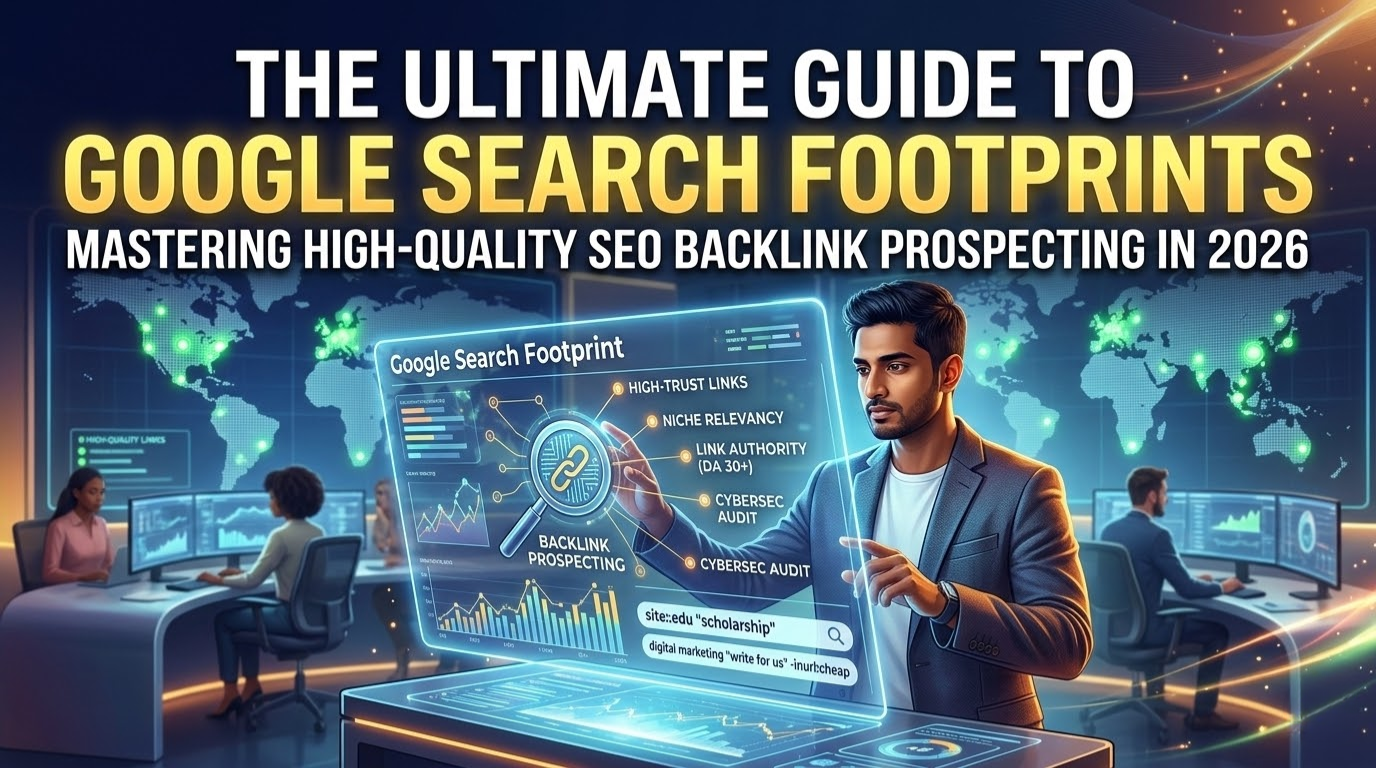
Search Footprints are advanced combinations of Google Search Operators that act as “filters” for the index. By using specific syntax, you can force Google to return only pages that meet your criteria—such as pages explicitly looking for guest contributors or resource listings.
For example, a generic search for “Digital Marketing” returns millions of results. However, a footprint like digital marketing "write for us" narrows it down to websites actively seeking content partners.
Section 2: The Master List of SEO Footprints (Categorized)
A. Guest Post & Contribution Footprints
These are essential for landing editorial links in 2026.
Keyword "guest post by"Keyword "submit an article"Keyword "contribute to our site"Keyword "guest post guidelines"Keyword inurl:category/guest-post
B. Resource & Link List Footprints (The Trust Signals)
Resource pages are curated lists of top industry tools or blogs. Getting your link here provides immense ranking power.
Keyword "best resources"Keyword "top 10 blogs"Keyword inurl:resourcesKeyword "recommended links"
C. Competitive Intelligence (The “Spy” Method)
Track exactly where your competitors are getting their mentions without expensive tools.
"Competitor Name" -site:competitorwebsite.com"Competitor Name" "guest post"
Section 3: 2026 Advanced Filtering (Removing the Spam)
The secret to high-quality SEO is not just what you find, but what you exclude. Use these filters to keep your list clean:
- Exclude Web 2.0 Spam:
-inurl:sites.google.com(removes low-quality Google Sites). - Freshness Filter: Use Google’s “Tools” menu to filter by the “Past Year” to ensure the site is still active.
- Geo-Targeting (TLDs): If targeting specific markets like the UK or UAE, use:
Keyword "write for us" site:.ukorsite:.ae.
Section 4: The Step-by-Step Backlink Strategy
- Prospecting: Generate a list of 100+ potential targets using the footprints above.
- Vetting (The Quality Audit): Filter sites by Domain Authority (DA 30+) and keep the Spam Score below 5%.
- The “Pre-Outreach” Engagement: Comment on their latest blog or share their content on LinkedIn to get on their radar.
- The High-Conversion Pitch: Send a personalized email offering a unique data point or a fresh angle they haven’t covered.
Section 5: The Agency Perspective (NSA Digital Strategy)
As a specialist agency, we focus on Niche Relevancy. A link from a tech site is worth more to a software client than 10 links from a generic news site.
- E-commerce Clients: Use footprints like
Keyword "product review"to find influencers. - B2B Tech Clients: Use
Keyword "whitepaper" "resources"to find high-trust academic or industry links.
Section 6: Common Pitfalls to Avoid in 2026
- Over-Optimization: Using the same “exact match” anchor text repeatedly can trigger a Google penalty.
- Ignoring Relevancy: Avoid “General” guest post sites that cover everything from ‘Weight Loss’ to ‘Crypto’ on the same page.
- Over-Automation: AI can help find footprints, but manual outreach is what actually secures the link.
Section 7: Advanced “Expert Roundup” Footprints
Roundups are great for E-E-A-T (Experience, Expertise, Authoritativeness, Trustworthiness).
"top 10 experts to follow" Keyword
"expert roundup" Keyword
"interview" "marketing agency head"
Here is the continuation and professional English translation for Sections 7 through 14, designed to complete your high-authority pillar blog.
Section 7: Footprints for “Brand Mentions” (The Unlinked Goldmine)
Sometimes, high-authority websites mention your agency or a client’s brand name but forget to include a backlink. These are known as Unlinked Brand Mentions, and they are the easiest links to acquire in 2026.
- The Footprint:
"[Brand Name]" -site:yourwebsite.com - How it works: This query returns every webpage that has mentioned your brand across the web while excluding your own site.
- The Strategy: Reach out to the webmaster with a friendly note: “Hey, we noticed you mentioned NSA Digital in your recent article! Thank you for the shoutout. Would you mind making that mention a clickable link so your readers can find us easily?”
- Why it works: These have a 3x higher conversion rate than cold guest posting because the author already knows and trusts your brand.
Section 8: Finding Educational & Government Backlinks (.edu & .gov)
In the eyes of search engines, one .edu or .gov link can carry more weight than 100 standard .com links. These are the ultimate “Trust Signals.”
- Scholarship Footprints:
site:.edu "scholarship" [Keyword] - Resource List Footprints:
site:.gov "resources" "digital marketing" - University Blog Footprints:
site:.edu inurl:blog "guest post" - Agency Tip: Offer universities guest lectures or articles on “Modern Career Trends” or “The Future of Digital Marketing in 2026.” Universities are always looking for real-world expertise for their students.
Section 9: Advanced Negative Filtering (Cleaning the Noise)
When using footprints, you will often find results cluttered with “Coupon,” “Deals,” or low-quality “Directories.” To find high-quality editorial sites, you must filter these out.
- The Footprint:
[Your Footprint] -inurl:coupon -inurl:cheap -inurl:deals -inurl:free - Why this matters: This saves roughly 40% of your prospecting time. It forces Google to show you actual blogs and news outlets rather than spammy affiliate sites, ensuring your backlink profile remains “clean” and high-authority.
Section 10: Local SEO Footprints (Region-Specific Targeting)
Since your agency manages international portfolios, you need localized footprints to build regional authority in markets like Pakistan, the UK, and the UAE.
- Pakistan Specific:
[Keyword] "write for us" site:.pk - Middle East / Gulf Focus:
[Keyword] "guest contributor" site:.aeorsite:.sa - Local Business Listings:
[Keyword] "business directory" Karachi - Regional PR:
site:tribune.com.pk "contributor"orsite:dawn.com "letters to editor"
Section 11: Content Gap Analysis via Footprints
Footprints aren’t just for finding links; they are essential for Content Intelligence. You can use them to see what your competitors are doing better than you.
- The Footprint:
site:competitor.com intitle:"SEO trends 2026" - The Goal: Identify high-performing topics your competitors have covered that you haven’t. Once identified, use the Skyscraper Technique: write a significantly more detailed version of that content and reach out to the same sites that linked to your competitor.
Section 12: Footprints for “Expert Roundups” & Interviews
Getting featured in expert roundups boosts your agency’s E-E-A-T (Experience, Expertise, Authoritativeness, and Trustworthiness).
- The Footprints:
"expert roundup" [Keyword]"interview" "digital marketing agency""top experts" "SEO 2026""contributing author" "marketing agency head"
- Benefit: Being listed alongside other industry leaders signals to Google that you are a verified authority in your niche.
Section 13: Automation & Scaling (Tool Integration)
To maintain a 5,000-word level of productivity, you need to automate the manual search process.
- Google Alerts: Set your favorite footprints as alerts. Whenever a new “Write for us” page is indexed, you’ll get an email notification.
- ScrapeBox: For power users, this tool can harvest thousands of URLs based on footprints in minutes.
- Hunter.io / Snov.io: Use these to find the direct email addresses of the editors and site owners you discovered through your footprints.
Section 14: Conclusion – The Future of Link Building
As we move through 2026, link building is evolving from a technical “URL hunt” into a Relationship Building exercise. Google Search Footprints provide the map, but your value-add content is what secures the destination.
At NSA Digital, we believe that a successful SEO strategy is built on a foundation of trust and relevancy. Use these footprints to find the right partners, but lead with quality to win the rankings.