

A professional website can help a financial services company build trust, explain its services, and attract potential clients. But in the financial industry, an attractive design is only part of the solution. Your website must also protect sensitive information, communicate clearly, work smoothly on mobile devices, and make it easy for visitors to contact your business.
If you are planning to launch or upgrade a financial services website in Pakistan, choosing the right development strategy can save time, reduce future costs, and improve your online presence. This guide explains how to develop a website for a financial services company, from planning and design to security, SEO, and ongoing maintenance. You will also learn which features to prioritize, how to choose a development partner, and what factors influence the overall project cost.
Why Your Financial Services Business Needs a Professional Website
Customers often research a financial company online before requesting a consultation or sharing their information. Your website is an opportunity to demonstrate professionalism, answer questions, and explain why potential clients should consider your services.
A well-planned website can help your business:
- Build credibility: Present your company profile, team, qualifications, service details, and contact information.
- Generate leads: Encourage visitors to request consultations, submit inquiries, or book appointments.
- Improve online visibility: Help prospective customers discover your services through relevant Google searches.
- Explain complex services: Make financial products and processes easier to understand through clear content and useful examples.
- Support customers: Provide answers to common questions, service information, and helpful resources around the clock.
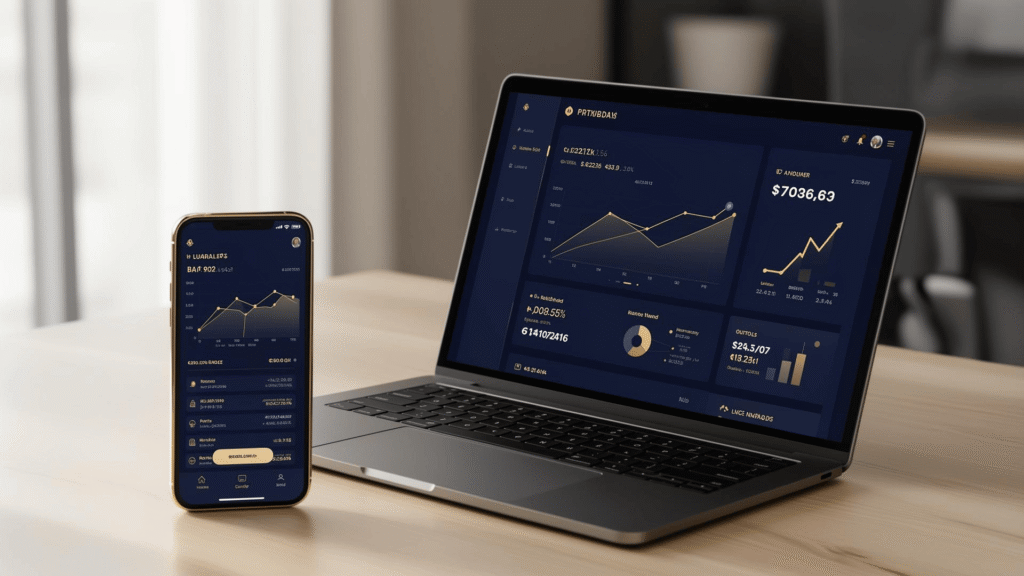
For example, a financial consultancy in Karachi could create dedicated pages for business accounting, tax consultancy, financial planning, and corporate advisory services. Each page could explain the service, identify its intended audience, and include a relevant inquiry form.
The goal is not simply to publish a website. It is to create a useful digital platform that supports your business objectives.
Step 1: Define Your Website Goals and Requirements
Before choosing a design or development platform, identify what your website needs to accomplish. Your business model, target customers, and service delivery process will determine which features you need.
Identify your target audience
Start by defining the people or businesses you want to reach. Your audience might include:
- Individuals seeking financial planning or advisory services.
- Small businesses looking for accounting and tax support.
- Companies requiring corporate finance or consulting.
- Customers comparing insurance or investment services.
- Users looking for digital payment or fintech solutions.
Understanding your audience helps you choose the right language, page structure, calls to action, and customer journey.
Decide which type of financial website you need
Not every financial business requires the same functionality.
Financial consultancy website: Focus on service pages, company credentials, consultation bookings, contact forms, and educational content.
Accounting or tax services website: Include service descriptions, document submission procedures where appropriate, appointment scheduling, and secure client communication.
Fintech company website: Explain the product, onboarding process, supported features, customer support, and relevant security practices. If the platform handles transactions or personal financial data, it may require substantial custom development and additional security reviews.
Financial advisory website: Present the firm’s services, team qualifications, methodology, risk disclosures, and clear information about the scope of its advice.
Write down your essential features before requesting quotations. This makes it easier to compare development proposals on a like-for-like basis.
Step 2: Plan Your Website Structure and Content
A clear website structure helps visitors find information and helps search engines understand your services.
For many financial services businesses, the following pages provide a practical starting point:
- Home: Introduce the business, core services, and main value proposition.
- About Us: Explain the company’s background, team, expertise, and relevant credentials.
- Services: Describe each service on a dedicated, detailed page.
- Industries Served: Explain which sectors or customer groups you support, if applicable.
- Resources or Blog: Publish useful articles that answer common customer questions.
- Contact Us: Provide business contact details, office information, and an inquiry form.
- Privacy Policy: Explain how personal information is collected, used, stored, and protected.
- Terms and Disclosures: Describe applicable terms, limitations, fees, risks, and other relevant disclosures.
Depending on your business and applicable requirements, you may also need complaint-handling information, regulatory disclosures, client login pages, or dedicated security documentation.
Create service pages that answer customer questions
Each service page should explain what you offer, who the service is for, how the process works, and what the customer should do next.
For instance, a business finance consultancy could structure a page around business challenges, its advisory process, deliverables, frequently asked questions, and a consultation request.
Avoid vague statements such as “We provide the best financial solutions.” Specific information about your process and expertise is more useful to prospective clients.
Step 3: Invest in Professional Fintech Website Design
Fintech website design should combine a professional appearance with a simple and predictable user experience. Visitors need to understand your business quickly, find the right information, and feel confident about taking the next step.
Prioritize usability and mobile responsiveness
Your website should work well on smartphones, tablets, laptops, and desktop computers. Important elements include:
- Readable text and clear headings.
- Simple navigation and descriptive menu labels.
- Forms that are easy to complete on smaller screens.
- Buttons with clear labels, such as “Request a Consultation.”
- Fast-loading pages and optimized images.
- Accessible color contrast, keyboard navigation, and form labels.
A visitor should not have to search through multiple menus to find your phone number or understand your services.
Use design elements that support trust
Choose a consistent visual identity that reflects your brand. A clean layout, professional typography, high-quality images, and well-organized content can make your company appear more credible.
Avoid exaggerated promises, confusing financial claims, fake testimonials, and unnecessary pop-ups. If you display testimonials, client logos, certifications, or performance figures, make sure you have permission to use them and can substantiate the claims.
Your website should communicate reliability through transparency and usability rather than decorative effects alone.

Step 4: Build a Secure Financial Website
Security is a core requirement for financial services website development. Even a business website that only collects inquiries must handle contact information responsibly. A platform that stores financial records, processes payments, or provides customer accounts requires more extensive controls.
Essential website security measures
Discuss the following safeguards with your development team:
- HTTPS and TLS: Encrypt information transmitted between the visitor’s browser and your website.
- Secure authentication: Use strong password policies, multi-factor authentication where appropriate, and secure account recovery.
- Role-based access: Give staff access only to the systems and information needed for their jobs.
- Software updates: Maintain the website platform, plugins, libraries, and server components.
- Data protection: Collect only the information you need and establish appropriate retention and deletion procedures.
- Backups and recovery: Maintain protected backups and test restoration procedures.
- Monitoring and logging: Track important security events and investigate suspicious activity.
- Security testing: Arrange suitable vulnerability assessments and penetration testing for systems with higher security risks.
- Incident response: Establish a documented process for investigating and responding to potential breaches.
An SSL/TLS certificate alone does not make a website secure. Security also depends on application design, configuration, access management, maintenance, and operational practices.
Consider Pakistan’s financial regulatory environment
The applicable requirements depend on the type of financial business you operate. A general financial consultancy website may have very different obligations from a regulated bank, digital lender, securities business, or payment institution.
In Pakistan, relevant organizations and resources may include the State Bank of Pakistan (SBP) and the Securities and Exchange Commission of Pakistan (SECP). For example, SBP publishes security and technology risk requirements for relevant regulated financial institutions and payment providers.
Before launching features such as digital onboarding, payment processing, investment services, or online lending, obtain advice on the rules applicable to your business. Your developer should work with your compliance and legal advisers to translate those requirements into technical and operational controls.
Do not assume that a website is compliant simply because it uses encryption or a secure hosting provider.
Step 5: Choose the Right Website Development Platform
Your development platform should match your business requirements, budget, security needs, and plans for future growth.
WordPress for service-based financial businesses
WordPress can be suitable for financial consultancies, accounting firms, advisory businesses, and companies that primarily need marketing content and lead generation.
Potential benefits include:
- Flexible page design and content management.
- Dedicated service pages and blog publishing.
- SEO-friendly website structures when configured correctly.
- Integration with suitable appointment, CRM, and analytics tools.
- The ability for staff to update content without rebuilding the website.
However, WordPress still requires secure configuration, reliable hosting, controlled plugin use, updates, backups, and ongoing maintenance.

Custom development for complex financial platforms
Custom development may be more suitable when your project requires customer dashboards, sophisticated permissions, integrations with financial systems, transaction processing, or specialized workflows.
The development process may involve:
- Requirements analysis and technical architecture.
- Interface design and user journey planning.
- Backend and frontend development.
- Integration with approved third-party services.
- Security testing and quality assurance.
- Deployment, monitoring, and ongoing support.
A hybrid approach is also possible: a content-managed marketing website alongside a separately secured customer portal or application.
Choose technology based on the actual requirements, not simply because a platform is popular or described as advanced.
Step 6: Understand Financial Website Development Cost in Pakistan
The financial website development cost depends on the scope of the project rather than a single standard price. A simple company website and a fully integrated fintech platform have very different design, development, security, and maintenance requirements.
The following are illustrative planning ranges in Pakistani rupees, not verified market averages or quotations. Actual prices vary by provider, project scope, and required assurance.
| Website type | Illustrative budget |
|---|---|
| Basic financial services website | PKR 50,000–150,000 |
| Professional business website with custom design and lead generation | PKR 150,000–400,000 |
| Advanced website with client portal or integrations | PKR 400,000–1,200,000+ |
| Complex fintech platform with transactions or specialized workflows | PKR 1,200,000–5,000,000+ |
These ranges are indicative only. Complex regulated products may cost substantially more, and a client portal is not equivalent to a complete financial application.
What affects the development price?
Design and content: Custom page layouts, original graphics, professional copywriting, and multilingual content can increase the budget.
Features and integrations: CRM connections, appointment scheduling, payment gateways, client dashboards, and third-party APIs require additional work.
Security requirements: Security architecture, independent testing, compliance support, and specialized infrastructure can materially affect the price.
Hosting and maintenance: Domain registration, hosting, backups, monitoring, software updates, and support may be recurring expenses.
Project scope: The number of pages, revision rounds, content migration, and delivery deadlines also influence the quotation.
How to compare website development quotations
Ask every provider to specify:
- Included pages and features.
- Design and content responsibilities.
- Hosting, domain, and third-party subscription costs.
- Security measures and testing deliverables.
- Expected timeline and milestone payments.
- Website ownership, source code, and administrator access.
- Warranty, maintenance, and post-launch support.
- Exclusions and charges for additional work.
The lowest quotation may not offer the best overall value if it excludes important functionality or ongoing security work.
Step 7: Optimize Your Website for SEO and Lead Generation
A professional website needs a clear strategy for attracting relevant visitors and converting them into inquiries. Search engine optimization should be included in the project from the planning stage rather than added as an afterthought.
Build a useful keyword and content strategy
Research the terms potential customers use when looking for financial services in Pakistan. Depending on your offering, relevant themes may include financial consultancy, business accounting services, fintech solutions, and financial website development.
Create a dedicated page for each major service where that page offers genuine value. Include relevant keywords in titles, headings, page copy, image alt text, and internal links where they fit naturally.
Avoid creating multiple near-identical pages simply to target different cities or variations of the same keyword.
Implement technical SEO
Ask your developer to configure:
- Search-engine-accessible navigation and internal links.
- Descriptive page titles and meta descriptions.
- A logical heading structure.
- XML sitemaps and appropriate robots.txt rules.
- Canonical URLs where needed.
- Mobile-friendly layouts and good Core Web Vitals.
- Image compression and descriptive alt text.
- Appropriate structured data.
- Google Search Console and analytics, with suitable privacy controls.
A fast, accessible website makes it easier for people to use your services, although technical optimization alone cannot guarantee higher rankings.
Turn visitors into qualified leads
Place clear calls to action on service pages, such as “Book a Consultation,” “Request a Proposal,” or “Contact Our Team.”
Keep inquiry forms focused on the information needed for an initial conversation. Avoid collecting identity documents, bank details, account credentials, or other sensitive financial information through a basic marketing form.
Where appropriate, connect inquiries to a CRM system, track completed forms, and measure which pages generate relevant leads. This allows you to improve the website using actual business outcomes rather than traffic numbers alone.
Step 8: Test, Launch, and Maintain Your Website
Before launch, test the website across common browsers and screen sizes. Confirm that forms work, contact details are correct, links open properly, and important pages load as expected.
Your launch checklist should include:
- Testing all forms, buttons, and integrations.
- Checking mobile responsiveness and accessibility.
- Verifying HTTPS and redirect behavior.
- Reviewing page titles, meta descriptions, and indexing settings.
- Configuring analytics and conversion tracking.
- Confirming backups and recovery procedures.
- Testing relevant security controls.
- Reviewing privacy notices, disclosures, and approved content.
- Confirming ownership of the domain, hosting, and website accounts.
After launch, schedule software updates, monitor availability, review security alerts, test backups, and fix broken links or outdated content.
Financial services businesses should also review their website copy and disclosures whenever services, fees, product terms, or applicable requirements change.
How to Choose a Financial Services Website Development Company
Choosing a capable development partner can reduce project risks and make future improvements easier.
Evaluate potential agencies against these criteria:
- Relevant experience: Ask to see genuine projects involving financial, professional, or other trust-sensitive services.
- Technical capability: Confirm that the team can deliver your required integrations, security controls, and performance standards.
- SEO knowledge: Check whether the proposal covers site structure, metadata, indexing, analytics, and conversion tracking.
- Transparent pricing: Request a written scope, timeline, deliverables, and exclusions.
- Security and ownership: Confirm who controls the domain, hosting, source code, administrator accounts, and backups.
- Ongoing support: Understand how maintenance, security incidents, updates, and future improvements will be handled.
Ask for a discovery discussion before committing to a complex project. A reliable provider should ask questions about your business, users, workflows, and security requirements before recommending a solution.
Conclusion
Developing a successful financial services website requires more than attractive visuals. You need a clear business strategy, intuitive navigation, relevant service content, appropriate security controls, technical SEO, and a practical plan for ongoing maintenance.
For businesses in Pakistan, the right approach depends on whether you need a lead-generation website, a financial consultancy platform, or a more complex fintech application. Define your requirements first, compare providers carefully, and ensure that security and applicable regulatory obligations are addressed from the beginning.
If you are planning a new project or upgrading an existing website, contact a professional website development agency to discuss your goals, required features, estimated budget, and delivery timeline. A well-planned project can give your business a stronger digital foundation and a clearer path to generating qualified inquiries.