

Search engine optimization relies heavily on accurate data. When the tools we trust experience prolonged technical difficulties, it causes a ripple effect across reporting, strategy, and stakeholder communication. For nearly a year, SEO professionals and site owners have been grappling with exactly this scenario due to a persistent data logging error within Google Search Console. You can read more details about the issue and its fix on Search Engine Land.
Google has finally announced a resolution to this widespread issue. The fix brings a much-needed sigh of relief to digital marketers everywhere. However, the update comes with a significant caveat regarding the historical data logged during the affected period. For more insights, you can check out the original coverage on Search Engine Land.
This post breaks down the timeline of the Google Search Console logging error and examines how the recent fix actually works. You will learn exactly which metrics were compromised, which ones remained accurate, and how to handle the frustrating data gap in your upcoming SEO performance reports. For further reading, see this detailed article on Search Engine Land.
Details of the Logging Error (May 2025 – April 2026)
The trouble began on May 13, 2025. Webmasters started noticing unusual, often alarming drops in their Google Search Console performance reports. For many websites, it looked as though their visibility in the search results had plummeted overnight. For more on the background of this issue, see this coverage by Search Engine Land.
After initial panic and widespread speculation across the SEO community, it became clear that the issue was not related to a core algorithm update or widespread manual penalties. Instead, it was a reporting glitch on Google’s end. The system was simply failing to log a substantial portion of search data. For a detailed technical overview of the problem, see this Google support page.
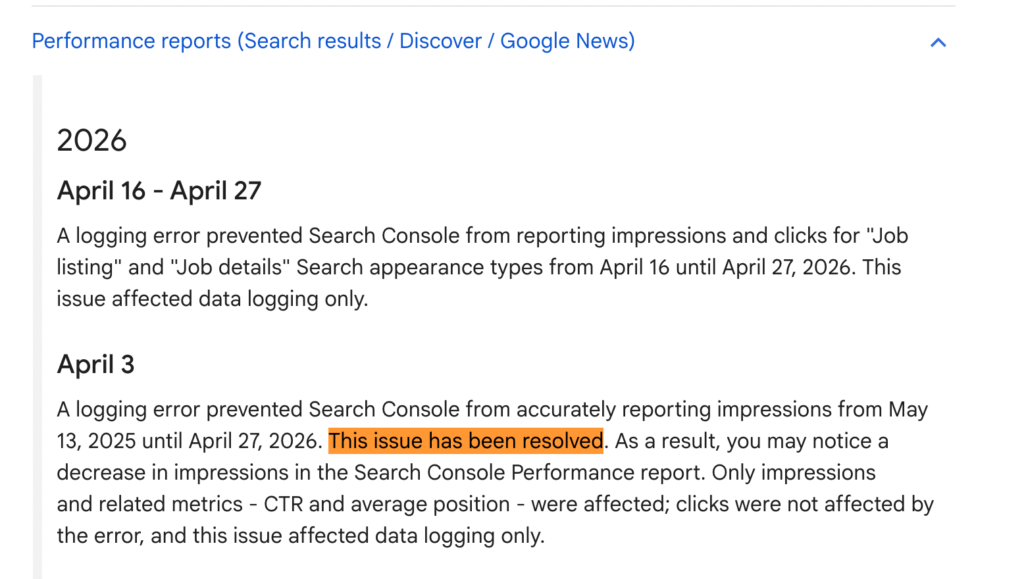
This logging error persisted for nearly a full year. Between May 13, 2025, and April 27, 2026, the performance reports within Google Search Console were highly unstable. Some days showed massive data gaps, while others appeared relatively normal. This inconsistency made it incredibly difficult to accurately track website growth, measure the success of new content campaigns, or audit technical SEO improvements. For additional reporting on the incident, you can visit Search Engine Land’s article on the issue.
What Google officially stated regarding the resolution
On April 27, 2026, Google successfully deployed a patch to resolve the underlying systems issue causing the reporting errors. The search engine giant confirmed that the data pipeline is now functioning normally, and performance reports will accurately reflect user behavior moving forward. For the official announcement, refer to Google’s Search Central documentation.
John Mueller, a Search Advocate at Google, publicly confirmed the resolution on Bluesky. He noted that the engineering team had identified the root cause and applied a permanent fix to the data logging infrastructure. You can read his confirmation and further discussion about the fix in this Bluesky post.
However, there is a major catch to this resolution. The fix only applies to data collected from April 27, 2026, onward. Google has explicitly stated that the historical data from the 11-month period of the outage cannot be recovered. The numbers you see in your dashboard between May 2025 and April 2026 will remain permanently inaccurate. The missing data was simply never logged by Google’s servers, meaning there is no backup to restore. For more information, see the official Google Search Central documentation.
The Impact: Which metrics are affected and which are not
Understanding exactly how this bug warped your data is crucial for accurate reporting. For more background and technical analysis, see this detailed Search Engine Land article. The logging error did not break every metric equally. Knowing what to trust and what to ignore will save you hours of confusion.
Metrics that were compromised
The logging error primarily impacted metrics tied to search visibility and user interaction within the search engine results pages (SERPs). For a detailed breakdown of how these metrics were affected, see this analysis by Search Engine Land. The following data points from May 13, 2025, to April 27, 2026, are unreliable:
- Impressions: This was the most noticeably affected metric. Google frequently failed to record when your website appeared in the search results.
- Click-Through Rate (CTR): Because CTR is calculated by dividing clicks by impressions, the massive drop in logged impressions caused CTR numbers to artificially spike. You might see unnaturally high CTR percentages during the bug period.
- Average Position: The failure to log impressions also skewed the average ranking position. Without a complete picture of where and when a site was shown, the mathematical average became entirely distorted.
Metrics that remained accurate
Fortunately, the core objective of most SEO campaigns—getting users to actually visit your website—remained trackable. For further insights on unaffected metrics, see this official update from Google.
- Clicks: The logging issue did not affect the tracking of clicks. If a user clicked on your website in the search results, Google Search Console successfully recorded that action. You can confidently rely on your click data for the entirety of the 11-month period. Furthermore, because clicks were unaffected, your Google Analytics (or alternative web analytics software) traffic data remains completely accurate and reliable.
Navigating the GSC Data Gap in SEO Reporting
The reality of a permanent, 11-month data gap can be frustrating, especially when it comes time to present year-over-year (YoY) growth to clients or internal stakeholders. For additional analysis on how to approach this, see this Search Engine Roundtable post. However, a few proactive adjustments can help you navigate this anomaly smoothly.
First, you must annotate your reporting dashboards. If you use Looker Studio or other data visualization tools connected to Google Search Console, clearly mark the period between May 13, 2025, and April 27, 2026. A simple visual disclaimer prevents executives or clients from misinterpreting the artificially low impressions as a massive drop in actual performance. For further guidance, see this step-by-step article on interpreting Search Console anomalies.
Second, shift your historical reporting focus entirely to clicks and actual website sessions. Since impressions and average position are effectively useless for that specific timeline, pivot your narrative to the traffic that actually arrived on the site. Use Google Analytics data to supplement the story, showing how organic sessions, conversions, and revenue trended during that time. For more on the best practices for working with historical data gaps, see this Google support article.
Finally, establish a new baseline starting from April 27, 2026. As the newly accurate data rolls in, you can begin tracking true impressions and CTR once again. By treating this date as a fresh start for visibility metrics, you can maintain the integrity of your future SEO analysis. For additional information on managing baselines after data anomalies, see this helpful guide from Google Search Central.